
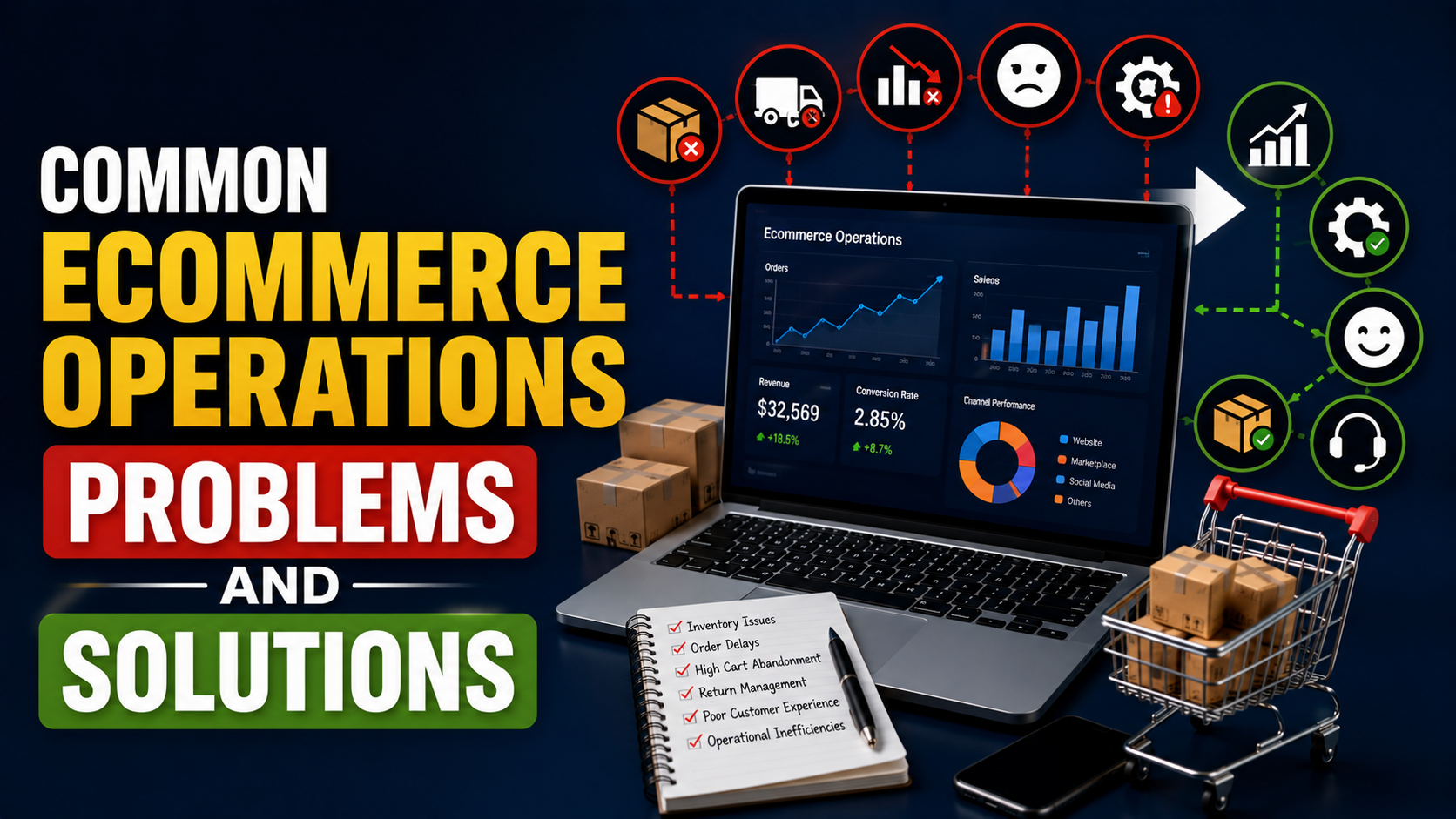
Common Ecommerce Operations Problems and Solutions
Running an eCommerce business is exciting. The ability to reach customers across Amazon, Walmart, eBay, Shopify, Etsy, and other marketplaces gives brands tremendous growth opportunities. However, behind every successful online store is a complex operation that requires planning, coordination, and constant attention.
In the early stages, many businesses manage everything themselves. They update listings, process orders, answer customer questions, track inventory, and monitor advertising campaigns. While this approach may work when order volumes are low, it becomes increasingly difficult as the business expands.
As sales grow, small operational issues that once seemed manageable can quickly turn into major obstacles. Delayed shipments, inventory shortages, rising advertising costs, and customer complaints can affect profitability and damage a brand’s reputation.
The reality is that operational challenges are not a sign of failure. They are often a sign that a business is growing and needs stronger systems to support that growth.
At Amz Northland, we help eCommerce brands identify operational bottlenecks, improve efficiency, and build scalable processes that support long-term success.
Why Ecommerce Operations Become More Complex
Most entrepreneurs begin with a simple goal: sell great products and provide excellent service.
Initially, managing operations feels straightforward. Orders are manageable, inventory is easy to track, and customer inquiries are limited. Then growth happens.
A business starts selling more products, expanding into new marketplaces, launching advertising campaigns, and introducing additional SKUs. Suddenly, tasks that once took an hour each day require an entire team.
Without efficient processes, businesses often find themselves constantly reacting to problems instead of focusing on growth opportunities.
This is where operational excellence becomes critical. The brands that scale successfully are not necessarily those with the biggest budgets. They are often the businesses that build systems capable of supporting increasing complexity.
Problem 1: Inventory Stockouts and Overstocking
Inventory management is one of the most common operational challenges in eCommerce.
Running out of stock means missed sales opportunities. Customers who cannot find your products may purchase from competitors instead. Frequent stockouts can also negatively impact marketplace rankings, making it harder to recover lost visibility.
At the same time, ordering too much inventory creates its own problems. Excess stock increases storage costs, ties up cash flow, and may lead to markdowns if products do not sell as expected.
Many businesses struggle because they rely on estimates rather than accurate forecasting.
The Solution
Inventory decisions should be guided by data rather than assumptions.
Review historical sales patterns, monitor seasonal trends, and account for upcoming promotions before placing purchase orders. Regular inventory reviews help businesses identify fast-moving products and avoid costly surprises.
The goal is balance: enough stock to meet demand without creating unnecessary expenses.
Problem 2: Inconsistent Product Listings
As brands expand into multiple channels, maintaining consistent product information becomes more challenging. Different product titles, outdated descriptions, inconsistent images, and missing specifications can confuse customers and weaken trust.
A customer who sees conflicting information across channels may hesitate to complete a purchase. Inconsistent listings can also contribute to higher return rates because expectations are not clearly set.
The Solution
Develop a standardized approach to product content. Ensure that product information remains accurate and consistent across every marketplace while adapting to each platform’s requirements.
Strong listings not only improve customer confidence but also support better visibility and conversion rates.
At Amz Northland, listing optimization focuses on creating content that appeals to both marketplace algorithms and shoppers.
Problem 3: Rising Advertising Costs
Advertising has become essential for visibility on major marketplaces.
However, many businesses notice that advertising expenses continue increasing while profits remain unchanged. This often happens when campaigns are launched without ongoing optimization.
Businesses may target broad keywords, overlook wasted spend, or fail to adjust strategies based on performance data.
The result is frustration and declining profitability.
The Solution
Advertising should be treated as an investment rather than an expense. Regularly analyze campaign performance, identify profitable keywords, and eliminate areas of inefficiency.
Optimizing bids, refining targeting, and improving product listings can significantly improve advertising returns.
Effective advertising is not about spending more. It is about spending smarter.
Problem 4: Order Fulfillment Delays
Customer expectations have changed dramatically. Fast and reliable shipping is no longer viewed as a bonus. It is expected.
When businesses struggle to fulfill orders promptly, customer satisfaction declines. Negative reviews increase, marketplace metrics suffer, and repeat purchase rates often decrease.
As order volumes grow, fulfillment systems that once worked efficiently can begin to break down.
The Solution
Evaluate your fulfillment process regularly. Identify where delays occur and implement improvements before they impact customers.
Whether fulfillment is handled internally or through third-party providers, consistency and reliability should remain priorities.
Timely deliveries strengthen customer trust and support positive marketplace performance.
Problem 5: Customer Service Challenges
Exceptional customer service can set an eCommerce brand apart from competitors. Unfortunately, many businesses become overwhelmed by increasing volumes of customer inquiries.
Delayed responses, unresolved concerns, and inconsistent communication often lead to dissatisfaction. Customers remember how businesses handle problems.
A poor service experience can damage brand perception, while a positive interaction can build lasting loyalty.
The Solution
Establish clear customer service standards. Respond promptly, communicate professionally, and use customer feedback to identify recurring issues that may require operational improvements.
Investing in customer satisfaction often generates returns through stronger reviews and repeat business.
Problem 6: Managing Multiple Marketplaces
Selling across Amazon, Walmart, Shopify, eBay, Etsy, and other channels creates enormous opportunities. It also introduces complexity.
Each platform has its own policies, algorithms, advertising systems, and operational requirements. Trying to manage everything manually often leads to mistakes and inefficiencies.
Business owners may feel as though they are constantly switching between platforms without making meaningful progress.
The Solution
Create structured workflows that support consistency. Document processes for listing updates, inventory reviews, performance monitoring, and reporting.
When systems are standardized, scaling becomes significantly easier. Successful multi-channel brands focus on building repeatable processes rather than relying on improvisation.
Problem 7: Making Decisions Without Data
Many operational decisions are based on instinct. While experience is valuable, relying solely on assumptions can limit growth.
Without reviewing data, businesses may overlook opportunities or fail to recognize emerging problems.
Questions such as which products generate the highest margins, or which campaigns deliver the best returns require objective analysis.
The Solution
Develop a habit of reviewing performance metrics regularly.
Analyze sales trends, profitability, inventory turnover, advertising results, and customer feedback.
Data-driven businesses tend to make faster, smarter decisions and adapt more effectively to changing market conditions.
Problem 8: Trying to Do Everything Yourself
This is perhaps the most overlooked challenge in eCommerce.
Many entrepreneurs wear multiple hats. They manage operations, oversee advertising, communicate with customers, monitor inventory, and plan future growth.
While this level of involvement demonstrates commitment, it can eventually become a barrier to scaling. Business owners often spend so much time solving daily problems that they have little time left for strategic thinking.
Growth creates stress instead of opportunity.
The Solution
Recognize when support is needed.
Delegating operational responsibilities allows leaders to focus on innovation, partnerships, and expansion.
The strongest businesses are rarely built by one person trying to do everything alone.
When Operational Challenges Start Limiting Growth
Every eCommerce business experiences occasional setbacks. However, repeated problems are often signals that existing systems are no longer sufficient.
If your team constantly struggles with stock shortages, customer complaints, advertising inefficiencies, or fulfillment issues, it may be time to reevaluate your operations.
Growth should not feel chaotic. Businesses that invest in better processes before problems escalate are better positioned to maintain profitability and deliver exceptional customer experiences.
Operational excellence becomes a competitive advantage.
How Expert Support Can Help
As eCommerce becomes more competitive, many brands choose to work with marketplace specialists to strengthen their operations. Expert support provides access to experience, proven strategies, and objective insights.
Rather than constantly reacting to problems, businesses can implement proactive solutions that support long-term growth.
At Amz Northland, we help brands optimize listings, improve advertising performance, streamline operations, and build scalable systems that evolve alongside their businesses. Our goal is not simply to solve today’s problems but to prepare businesses for tomorrow’s opportunities.
Conclusion
Operational problems are a normal part of running an eCommerce business. What separates successful brands from struggling ones is how they respond to these challenges.
Inventory issues, rising advertising costs, fulfillment delays, customer service concerns, and multi-channel complexities do not have to limit growth.
With the right systems, clear processes, and a willingness to adapt, these challenges can become opportunities for improvement.
The most successful eCommerce businesses understand that operational efficiency is not just about reducing errors. It is about creating the foundation for sustainable growth, stronger customer relationships, and long-term profitability.
At Amz Northland, we help brands overcome operational obstacles and build the infrastructure needed to scale confidently in today’s competitive marketplace.
Recent Posts
- Pricing for Profit: Setting Margins and Minimum Order Quantities for Wholesale Buyers
- Mobile-First Storefronts: Designing Seamless Experiences for Smartphone Shoppers
- The Content Advantage: How Rich Media Content Drives Repeat Customer Loyalty
- The Zero-Error Checklist: Preventing Common Operational Mishaps During Product Releases
- The First 30 Days: Engineering Momentum for a New Product Launch
- Writing Copy That Sells: Overcoming Friction Points in Product Descriptions
- The High-Converting Shopify Product Page: Anatomy of a Seamless Checkout Flow
- Google SEO vs. Marketplace SEO: Why Winning on Google Doesn’t Mean Winning on Amazon
- The 2026 E-Commerce Landscape: Decentralization, AI Agents, and Unified Feeds
Archives
- September 2026 (16)
- August 2026 (24)
- July 2026 (26)
- June 2026 (26)
- May 2026 (26)
- April 2026 (11)
- October 2025 (4)
- September 2025 (5)
Frequently Asked Questions
Inventory management, fulfillment delays, advertising inefficiencies, customer service issues, and managing multiple marketplaces are among the most common challenges.
Higher order volumes, expanded product catalogs, and additional sales channels create greater complexity that requires stronger systems and processes.
Using historical data, forecasting demand, and conducting regular inventory reviews can help maintain healthy stock levels.
Efficient operations improve profitability, enhance customer experiences, and support long-term growth
If operational tasks are consuming too much time or recurring issues are affecting performance, professional assistance may be beneficial.
Amz Northland provides marketplace management, listing optimization, PPC management, operational support, and growth strategies designed to help eCommerce brands scale successfully.
Recent Comments