


AI Product Infographics: How to Highlight Features Clearly
In today’s competitive eCommerce landscape, professional product images play an important role in helping customers understand products and make purchasing decisions. Shoppers often browse multiple listings before choosing a product, making clear visuals essential for attracting attention and communicating value. AI product infographics offer an effective way to present product features, specifications, and benefits in a visually engaging format.
For businesses selling through Amazon, Walmart, eBay, Etsy, Shopify, and other online marketplaces, combining artificial intelligence with professional design can improve product presentation and strengthen listing optimization.
This guide explains how to create effective AI product infographics, highlight important features clearly, and integrate visual content into a broader eCommerce marketing strategy.
What Are AI Product Infographics?
AI product infographics combine product photography, graphic design, icons, text, and artificial intelligence tools to communicate product information visually. They help shoppers understand important details without having to read lengthy descriptions.
For example, a product infographic for a shopping bag might highlight its dimensions, material, handle design, storage capacity, and practical uses. A technology product infographic might explain compatibility, technical specifications, and essential functions.
AI-powered design tools can assist with layouts, background generation, image editing, and creative concepts. However, human review remains important to ensure that product details are accurate and the final design meets marketplace requirements.
Why Are Product Infographics Important for eCommerce?
Online customers cannot physically examine products before purchasing them. High-quality product images and informative graphics help bridge this gap by presenting essential information clearly.
Well-designed infographics can explain product benefits, demonstrate functionality, answer common customer questions, and distinguish different product variations. They can also help shoppers compare specifications and understand which product best meets their requirements.
For sellers managing extensive product catalogs, AI-assisted design workflows can support the development of consistent visual assets across multiple listings.
The objective is not simply to create attractive images. It is to communicate useful information that supports customer confidence and makes product evaluation easier.
How to Highlight Product Features Clearly With AI
1.Identify the Most Important Product Features
Start by identifying the information customers need before purchasing. Depending on the product category, this might include dimensions, materials, functionality, compatibility, capacity, care instructions, or included accessories.
Prioritize the features that answer the most important customer questions. Avoid overcrowding an infographic with unnecessary information.
AI tools can help organize product specifications into visual content ideas, but the information should always be checked against verified product data.
2.Turn Product Features Into Customer Benefits
A feature describes what a product offers, while a benefit explains why it matters to the customer.
For example, instead of displaying only the phrase “multiple compartments,” an infographic could explain how separate compartments help organize everyday belongings.
This approach makes product information more meaningful and helps shoppers understand the practical value of individual features.
Use concise headings, simple icons, readable typography, and clear product photography to communicate each benefit effectively.
3.Use AI to Improve Visual Presentation
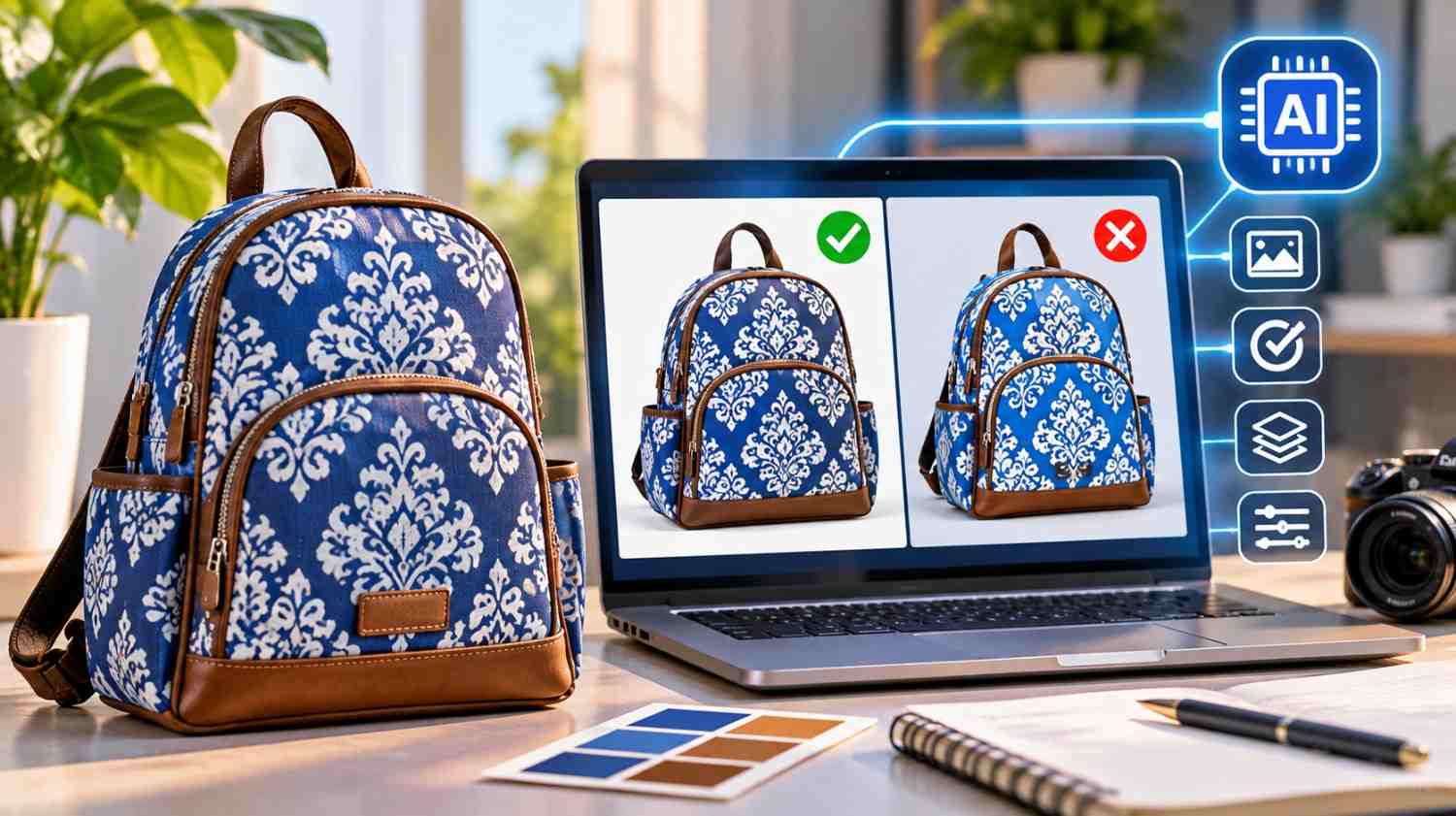
AI-assisted design tools can help generate creative concepts, remove distracting backgrounds, adjust lighting, and explore different layouts. These capabilities can support faster content production and more consistent product presentation.
However, AI-generated visuals should not alter important product characteristics. Colours, proportions, materials, components, and other defining details must accurately represent the item being sold.
A final quality check is essential, particularly when working with products that have specific patterns, textures, dimensions, or technical features.
4.Design for Mobile Shopping
Many customers browse online marketplaces using smartphones. Infographics must therefore remain readable on smaller screens.
Use short headlines, sufficient spacing, strong visual contrast, and a clear information hierarchy. Each image should communicate one primary message rather than attempting to explain every product detail simultaneously.
Before publishing, preview the images at smaller sizes to ensure that text, icons, and product features remain easy to understand.
Product Infographics for Amazon and Other Marketplaces
Different marketplaces have different image requirements and content opportunities. Sellers should review the relevant platform guidelines before uploading their creative assets.
For Amazon, the primary product image must follow the applicable main-image requirements. Informative graphics, feature callouts, dimensions, and comparison visuals are generally better suited to eligible secondary image placements or appropriate A+ Content modules.
For Walmart, eBay, Etsy, and Shopify, visual content should likewise reflect the platform’s requirements and the expectations of its customers.
Businesses selling across multiple channels should maintain consistent product information while adapting image formats and layouts to each marketplace.
Effective Marketplace Management connects product imagery with listing optimization, catalog accuracy, product descriptions, and ongoing performance analysis.
How Product Infographics Support SEO, GEO, and AEO
Search engine optimization (SEO), Generative Engine Optimization (GEO), and Answer Engine Optimization (AEO) can complement a strong visual content strategy.
SEO helps improve the discoverability of relevant product pages. GEO focuses on making information understandable and useful across AI-powered search experiences. AEO emphasizes clear answers to specific customer questions.
Product infographics can support these broader strategies when their information is reinforced by accurate product titles, descriptions, specifications, and relevant page content.
Businesses should also use descriptive image filenames and appropriate alternative text where supported. Important product information should remain available in accessible text rather than being communicated exclusively through graphics.
Combining clear visual assets with useful written content helps create a more complete product experience.
The Role of e-Commerce Photography and Marketing
Professional e-Commerce Photography provides the visual foundation for effective product infographics. High-quality product images show the actual item’s appearance, construction, details, and real-world applications.
Designers can build informative graphics around these images to explain dimensions, benefits, materials, and product differences.
When combined with e-Commerce Marketing, these assets become part of a broader strategy that includes listing optimization, marketplace advertising, product positioning, and customer engagement.
Businesses selling through multiple channels can also benefit from Online Marketplace Services that coordinate product content, catalog management, visual assets, and marketplace operations.
The effectiveness of these activities should be evaluated using relevant metrics, such as product-page engagement, conversion rate, and return reasons, rather than assuming that improved graphics automatically increase sales.
How AMZ Northland Supports AI Product Infographic Strategies
AMZ Northland helps businesses strengthen their online selling strategies through e-Commerce Marketing, Marketplace Management, e-Commerce Photography, and Online Marketplace Services.
Its marketplace-focused capabilities include product listing optimization, visual content development, infographic design, A+ Content, catalog management, and support for businesses selling across multiple online platforms.
By connecting product photography with accurate product information and marketplace optimization, AMZ Northland helps businesses develop more informative and consistent product listings.
Companies seeking to improve their product presentation can explore a strategy that aligns their creative assets with their marketplace requirements, target customers, and commercial objectives.
Conclusion
AI product infographics can make complex product information easier to understand by combining accurate photography, concise text, and thoughtful visual design. The strongest results come from prioritizing customer questions, highlighting meaningful benefits, maintaining product accuracy, and adapting content to individual marketplace requirements.
When supported by professional e-Commerce Photography, SEO, GEO, AEO, and effective Marketplace Management, product infographics can become a valuable part of a comprehensive online selling strategy.
Recent Posts
- AI Product Infographics: How to Highlight Features Clearly
- How to Keep Product Appearance Accurate in AI-Generated Images
- AI Product Photography for Small Businesses on a Budget
- How AI Product Images Can Improve Shopify Product Pages
- AI Lifestyle Product Photography: Benefits and Examples
- AI Product Photography: What It Is and How E-Commerce Brands Use It
- How to Create Amazon Product Images with AI
- AI Product Photography vs Traditional Studio Photography: Which Is Better for E-Commerce?
- Transitioning from Hobbyist to Professional Seller: Legal and Structural Requirements
Archives
- November 2026 (2)
- October 2026 (10)
- September 2026 (24)
- August 2026 (24)
- July 2026 (26)
- June 2026 (26)
- May 2026 (26)
- April 2026 (11)
- October 2025 (4)
- September 2025 (5)
Frequently Asked Questions
AI product infographics use artificial intelligence-assisted design, product images, text, and visual elements to explain product features, specifications, and benefits clearly.
They help communicate product information, answer common customer questions, simplify comparisons, and present important features in an easy-to-understand visual format.
Yes. AI tools can assist with infographic concepts, layouts, and image editing. Sellers must verify product accuracy and follow Amazon’s applicable image and content requirements.
Depending on the product, useful information may include dimensions, materials, key benefits, functionality, compatibility, usage instructions, and comparisons between relevant product variations.
Infographics can complement optimized product content by reinforcing important attributes and answering customer questions. Descriptive image filenames, alternative text, and supporting written information can improve accessibility and contextual understanding.
Professional e-Commerce Photography provides accurate, high-quality product images that help communicate appearance, construction, and important details. These images form a reliable foundation for informative graphics.
AMZ Northland provides e-Commerce Marketing, Marketplace Management, e-Commerce Photography, and Online Marketplace Services to help businesses improve product presentation, optimize listings, and coordinate their marketplace content strategies.

Recent Comments