
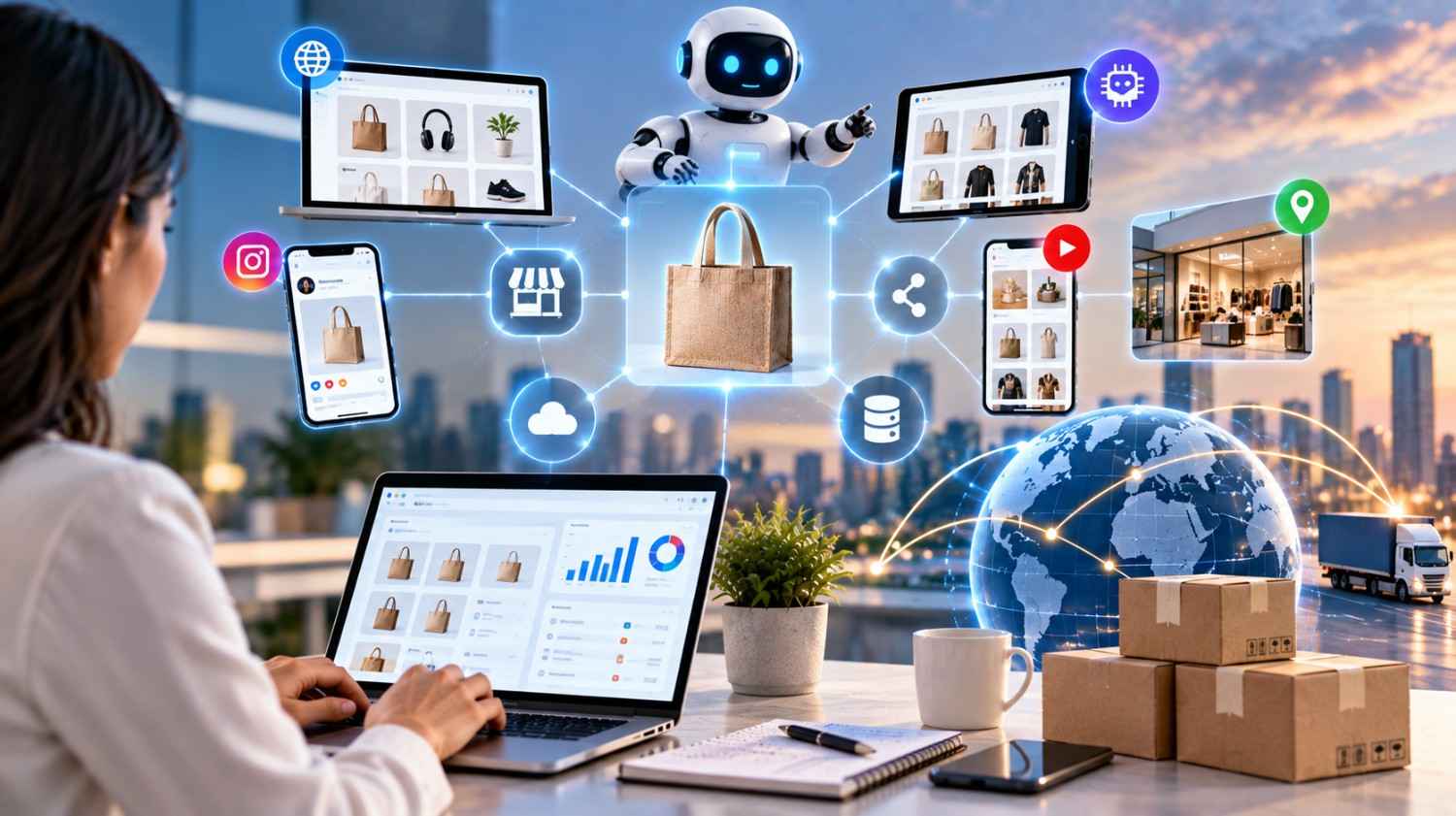

The 2026 E-Commerce Landscape: Decentralization, AI Agents, and Unified Feeds
The e-commerce landscape in 2026 is becoming more connected, automated, and data-driven. Brands are no longer competing only for visibility inside a single marketplace or search engine. Customers can discover products through marketplaces, social platforms, search engines, AI assistants, brand websites, and increasingly through AI-driven shopping experiences.
At the same time, sellers are managing more channels, more product data, more advertising campaigns, and more customer touchpoints. The challenge is no longer simply getting products online. It is creating a connected commerce system where product information, inventory, content, imagery, and customer experiences remain consistent across channels.
This is where e-Commerce Marketing, Marketplace Management, e-Commerce Photography, and Online Marketplace Services become increasingly important.
The Shift Toward a More Decentralized E-Commerce Model
E-commerce is becoming less dependent on a single storefront. Brands can sell through Amazon, Walmart, eBay, Etsy, Shopify, social commerce channels, direct websites, and other specialized marketplaces.
This creates opportunities for brands to reach customers in different environments, but it also creates operational complexity. Every additional channel can require product listings, images, pricing, inventory information, descriptions, advertising, and performance monitoring.
AMZ Northland currently supports brands across Amazon, Walmart, eBay, Etsy, Faire, Poshmark, Shopify, and other marketplaces, reflecting the growing importance of multi-channel commerce.
The goal in 2026 is therefore not simply to sell on more platforms. It is to build a coordinated ecosystem where every channel works from accurate and consistent product information.
AI Agents Are Changing Product Discovery
One of the most important developments in e-commerce is the growing role of AI agents and conversational shopping.
Instead of searching through dozens of product pages manually, consumers can increasingly ask AI-powered tools to research products, compare options, summarize reviews, and help them make purchasing decisions.
Recent industry reporting indicates that AI-referred traffic to retail platforms has grown significantly in 2026, with marketplaces benefiting from their large product catalogues, structured information, reviews, and established purchasing infrastructure.
This creates a new optimization challenge for sellers. Product information needs to be understandable not only to shoppers but also to systems that interpret and compare product data.
Clear titles, accurate attributes, detailed descriptions, high-quality images, structured catalog information, and consistent product data can all contribute to a stronger digital product presence.
Unified Feeds Are Becoming Essential
As brands expand across channels, maintaining accurate product information becomes increasingly difficult.
A product may have one title on Amazon, another on Walmart, a different description on Shopify, and inconsistent images or inventory information elsewhere. These inconsistencies can create operational problems and weaken the customer experience.
Unified product feeds provide a way to centralize important information and distribute it across connected sales channels.
A strong product feed can contain information such as product titles, SKUs, descriptions, categories, dimensions, images, prices, inventory, variations, and other product attributes.
AMZ Northland’s marketplace management services include catalog organization, inventory synchronization, SKU management, feed management, listing maintenance, and multi-marketplace coordination.
For growing brands, this type of centralized product-data approach can make multi-channel expansion more manageable.
Marketplace Management Becomes More Strategic
In previous years, marketplace management could be viewed primarily as maintaining listings and processing updates. In 2026, it increasingly involves coordinating an entire commerce ecosystem.
Marketplace Management can include product listing optimization, catalog management, advertising, inventory coordination, marketplace SEO, performance analysis, creative content, and expansion planning.
The more channels a brand operates, the more valuable centralized oversight becomes.
AMZ Northland provides marketplace management and consulting across Amazon, Walmart, eBay, Etsy, Poshmark, Faire, Shopify, and other platforms, with services covering listing optimization, catalog management, advertising, onboarding, and multi-marketplace strategy.
E-Commerce Photography Still Matters in an AI-Driven Market
While AI is transforming product discovery, visual presentation remains extremely important.
e-Commerce Photography helps customers understand products before purchasing. Clear product images can communicate dimensions, features, materials, colour, usage, and product quality more effectively than text alone.
Professional images also create useful visual assets that can be distributed across multiple channels.
AMZ Northland provides professional product photography, lifestyle imagery, infographics, and marketplace-focused visual content designed to improve product presentation and conversions.
As visual search and AI shopping become more important, maintaining accurate and consistent product imagery across channels can become part of a broader product-data strategy.
SEO Is Moving Toward AI-Readable Commerce
Traditional marketplace SEO remains important, but brands also need to think about how product information is interpreted by AI systems.
This means moving beyond keyword repetition toward comprehensive product information.
A product listing should clearly communicate what the product is, who it is for, its key features, available variations, use cases, and relevant specifications.
This creates a stronger foundation for traditional search while also making product information easier for AI systems and recommendation engines to interpret.
The transition from traditional SEO toward AI-supported discovery is particularly important as consumers increasingly use conversational interfaces to research products.
The Importance of Consistent Product Data
Consistency is becoming one of the foundations of modern e-commerce.
A customer who sees one product colour on a website and another on a marketplace may hesitate to purchase. Similarly, inaccurate inventory information can create poor customer experiences and operational problems.
Unified feeds can help brands maintain consistency between product databases and sales channels.
This is especially valuable for businesses operating large catalogues or selling across Canada and the USA, where different marketplaces, currencies, product variations, and customer expectations may need to be managed simultaneously.
AMZ Northland’s multi-marketplace services are designed to help brands standardize listings, coordinate marketplace strategies, manage product launches, and improve operational efficiency across multiple channels.
What E-Commerce Brands Should Prioritize in 2026
The strongest e-commerce strategies in 2026 will increasingly connect technology, data, content, marketplaces, and customer experience.
Brands should focus on creating reliable product data, maintaining high-quality product imagery, optimizing listings for marketplace search, managing inventory consistently, developing useful content, and preparing product information for AI-driven discovery.
Businesses should also avoid treating every channel as a completely separate operation. A connected approach allows product updates, content improvements, imagery, and strategic decisions to support multiple channels at the same time.
This is particularly important for brands expanding from one marketplace into several. Recent AMZ Northland guidance emphasizes that multi-marketplace growth requires coordinated management of product information, inventory, advertising, pricing, and customer expectations.
How AMZ Northland Supports the 2026 E-Commerce Landscape
AMZ Northland provides e-commerce growth and marketplace management services for brands selling across Canada, the USA, and other markets.
Its services include e-Commerce Marketing, Marketplace Management, e-Commerce Photography, and Online Marketplace Services, along with listing optimization, catalog management, A+ content, advertising support, product photography, and multi-marketplace consulting.
For brands navigating the 2026 e-commerce environment, AMZ Northland helps connect product content, marketplace operations, visual assets, and growth strategies across major commerce platforms.
The future of e-commerce is becoming more distributed, automated, and interconnected. Brands that build unified product data and coordinated marketplace systems can be better positioned to adapt as AI agents and new discovery channels continue changing how customers shop.
Recent Posts
- The 2026 E-Commerce Landscape: Decentralization, AI Agents, and Unified Feeds
- Optimizing for Visual Search: How Image Metadata Feeds AI Recommendation Engines
- Information Architecture: Designing Product Infographics That Answer Buyer Objections
- Lifestyle Imagery vs. Studio Shots: Which Visuals Actually Stop the Scroll?
- Designing a Cohesive Visual Brand Identity That Commands Premium Pricing
- Algorithmic Growth on Poshmark: Timing, Sharing, and Closet Curation Tactics
- The B2B Goldmine: Landing Independent Boutique Buyers Through Faire
- Long-Tail Dominance: How Small Brands Outrank Giants in Crowded Niches
- Scaling From One Store to a Multi-Marketplace Enterprise Without Burning Out
Archives
- September 2026 (8)
- August 2026 (24)
- July 2026 (26)
- June 2026 (26)
- May 2026 (26)
- April 2026 (11)
- October 2025 (4)
- September 2025 (5)
Frequently Asked Questions
E-commerce is becoming increasingly multi-channel and AI-driven. Brands are selling across more marketplaces while AI assistants, unified product feeds, and automated discovery are changing how customers find and evaluate products.
AI agents are software systems that can assist with tasks such as product research, comparison, recommendations, and shopping-related decisions. Their growing role makes accurate and structured product information increasingly important.
Unified feeds help businesses maintain consistent product information across multiple sales channels. They can simplify updates to titles, descriptions, images, inventory, pricing, variations, and other product data.
Marketplace Management helps coordinate listings, catalog data, advertising, inventory, optimization, and performance across online marketplaces. This can make multi-channel growth more organized and scalable.
e-Commerce Photography provides customers with clear visual information about products while helping brands maintain consistent presentation across marketplaces, websites, and other digital channels.
AI agents are changing product discovery, but traditional marketplace search remains important. Brands should prepare for both environments by maintaining strong marketplace SEO, accurate product data, high-quality content, and professional imagery.
Yes. AMZ Northland supports brands across Canada and the USA with e-Commerce Marketing, Marketplace Management, e-Commerce Photography, Online Marketplace Services, listing optimization, catalog management, advertising, and multi-marketplace growth strategies.
Recent Comments