
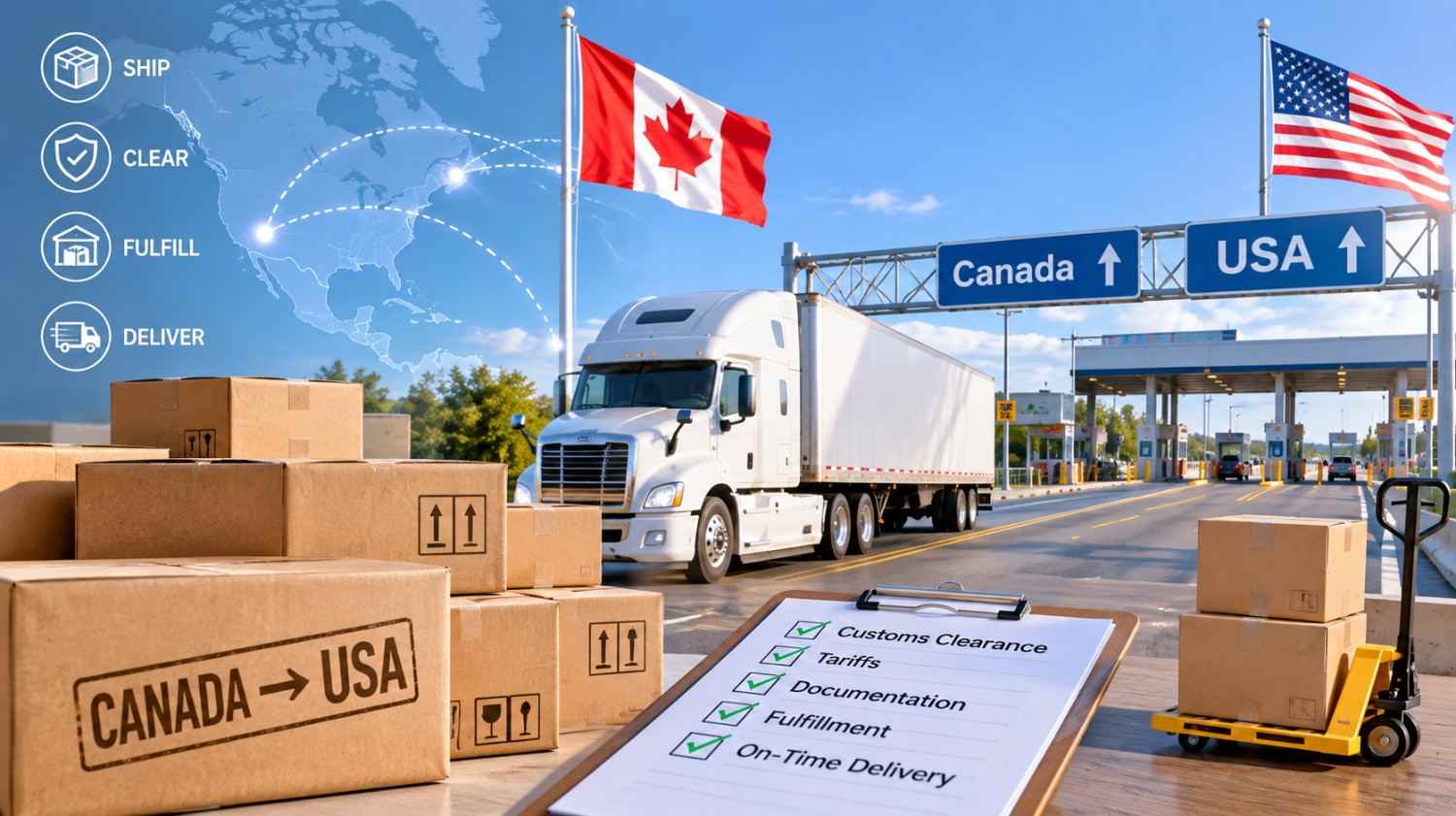
Crossing the Border: Navigating Customs, Tariffs, and Fulfillment from Canada to the USA
Expanding an eCommerce business from Canada to the USA can open access to a much larger customer market, but cross-border selling requires more than simply listing products on an American marketplace. Customs documentation, product classification, country of origin, tariffs, shipping arrangements, inventory planning, and fulfillment all need to work together.
For Canadian brands selling through Amazon, Walmart, eBay, Shopify, Etsy, and other channels, understanding the Canada-to-USA shipping process can help reduce unexpected costs and delivery problems.
Understanding Cross-Border Customs
Every commercial shipment entering the USA must meet applicable customs requirements. The classification of a product under the Harmonized Tariff Schedule helps determine the applicable duty treatment and other requirements. U.S. Customs and Border Protection notes that the correct duty rate depends on factors including the product’s classification and country of origin.
For an eCommerce seller, accurate product information is therefore essential. Product descriptions, quantities, declared values, country of origin, and classification information should be consistent across commercial invoices, shipping documentation, and marketplace records.
A small documentation error can create delays, additional processing, or unexpected costs. Building a standardized cross-border shipping workflow can make the process more manageable as order volume increases.
How Tariffs Can Affect Canadian Products
Tariffs are one of the most important considerations when shipping products from Canada to the USA. The amount applicable to a product can depend on its classification, origin, applicable trade programs, and current U.S. tariff measures.
Products that qualify under the United States-Mexico-Canada Agreement (USMCA) may receive preferential tariff treatment when the applicable origin requirements are satisfied. Businesses should maintain appropriate origin documentation and make accurate claims when requesting preferential treatment. CBP guidance explains that preferential treatment requires the importer to possess valid origin documentation for qualifying goods.
However, Canadian origin does not automatically mean every product receives the same tariff treatment. Products manufactured in Canada may contain materials from other countries, and the applicable origin rules can vary by product category.
Because tariff policies can change, sellers should verify the current requirements for their specific products before setting prices or calculating margins.
Why Product Classification Matters
Product classification is an important part of international eCommerce fulfillment. A product’s tariff classification can influence the duty rate and whether additional requirements apply.
For example, two products that appear similar to a consumer may have different classifications because of their materials, construction, intended use, or manufacturing process.
This makes accurate product data particularly valuable for brands managing large catalogs. Maintaining organized SKU information, product specifications, country-of-origin data, and classification records can help create a more consistent cross-border operation.
Preparing Orders for the USA
Once a customer places an order, the fulfillment process should account for the destination country from the beginning. Canadian sellers should determine whether orders will be shipped individually from Canada or whether inventory should be positioned closer to U.S. customers.
Direct shipping from Canada can work well for certain products and order volumes. However, as sales increase, storing inventory in a U.S.-based fulfillment facility may provide a different operational model, potentially improving delivery speed and simplifying the customer experience.
The appropriate approach depends on product size, sales volume, customer locations, shipping costs, inventory turnover, and marketplace requirements.
Understanding the De Minimis Environment
Canadian sellers should not assume that low-value shipments automatically receive duty-free treatment in the USA. CBP states that, effective August 29, 2025, duty-free de minimis treatment was suspended for covered shipments entering the USA, including shipments valued at or below $800, subject to the applicable exceptions and rules.
This change makes it particularly important for eCommerce sellers to understand how their shipments are entered, what duties and fees may apply, and who is responsible for the import process.
The financial impact should be considered when developing product pricing, shipping charges, promotions, and marketplace margins.
Building a Reliable Fulfillment Strategy
Cross-border fulfillment should be designed around the complete customer journey rather than shipping alone. A strong system connects inventory management, marketplace orders, warehouse operations, shipping carriers, customs documentation, tracking, and customer communication.
For brands selling across multiple marketplaces, this becomes even more important. Inventory needs to remain synchronized across channels so that a product advertised as available can actually be fulfilled.
AMZ Northland supports brands with Marketplace Management, listing optimization, catalog management, inventory coordination, advertising, and cross-border marketplace strategies across Canada and the USA.
How eCommerce Businesses Can Reduce Cross-Border Problems
The most effective approach is to create a repeatable process before increasing international order volume. Product data should be standardized, shipping costs should be reviewed regularly, and customs information should be maintained accurately.
Businesses should also evaluate whether direct fulfillment from Canada or U.S.-based inventory makes more sense for each product category. Fast-moving products may justify localized inventory, while lower-volume products may continue to be shipped internationally.
Pricing should also account for more than product cost. Shipping, brokerage, duties, marketplace fees, fulfillment charges, returns, and other cross-border expenses can affect the actual margin on every sale.
The Role of Marketplace Management
Cross-border growth becomes more complex when a brand sells through several platforms. Each marketplace can have different listing requirements, fulfillment settings, pricing structures, advertising tools, and customer expectations.
Professional Marketplace Management can help coordinate these moving parts while maintaining consistent product information across sales channels.
AMZ Northland provides Online Marketplace Services for brands selling through Amazon, Walmart, eBay, Etsy, Shopify, Faire, Poshmark, and other eCommerce platforms. Its services include marketplace onboarding, listing optimization, marketplace SEO, catalog management, advertising support, and multi-marketplace growth strategies.
Supporting Cross-Border Growth With Better Product Content
Successful international eCommerce is not only about logistics. Customers also need clear product information and compelling visuals before they make a purchase.
High-quality product images, accurate descriptions, keyword-optimized listings, A+ content, and consistent branding can improve the shopping experience across marketplaces.
AMZ Northland combines e-Commerce Marketing, Marketplace Management, e-Commerce Photography, and Online Marketplace Services to help brands strengthen their digital presence while expanding across Canadian and U.S. marketplaces.
AMZ Northland for Canada-to-USA eCommerce Growth
Crossing the Canada-USA border for eCommerce fulfillment requires coordination between product data, customs, tariffs, inventory, shipping, marketplace operations, and customer experience. Businesses that establish these processes before scaling can create a more organized foundation for cross-border growth.
AMZ Northland helps Canadian brands and cross-border eCommerce businesses manage marketplace operations, product listings, catalog systems, advertising, e-Commerce Marketing, Marketplace Management, e-Commerce Photography, and Online Marketplace Services. With support across Amazon, Walmart, eBay, Etsy, Shopify, Faire, and other platforms, AMZ Northland helps businesses build structured marketplace operations across Canada and the USA.
Recent Posts
- Crossing the Border: Navigating Customs, Tariffs, and Fulfillment from Canada to the USA
- Scaling DTC Brands: When to Bring SEO and Paid Media In-House vs. Outsourcing
- Hiring Your First E-Commerce Agency: Red Flags, Green Flags, and ROI Expectations
- Creating Digital Catalogs That Retail Buyers Can’t Resist
- Pricing for Profit: Setting Margins and Minimum Order Quantities for Wholesale Buyers
- Mobile-First Storefronts: Designing Seamless Experiences for Smartphone Shoppers
- The Content Advantage: How Rich Media Content Drives Repeat Customer Loyalty
- The Zero-Error Checklist: Preventing Common Operational Mishaps During Product Releases
- The First 30 Days: Engineering Momentum for a New Product Launch
Archives
- September 2026 (20)
- August 2026 (24)
- July 2026 (26)
- June 2026 (26)
- May 2026 (26)
- April 2026 (11)
- October 2025 (4)
- September 2025 (5)
Frequently Asked Questions
Cross-border eCommerce fulfillment is the process of storing, preparing, shipping, clearing, and delivering online orders from one country to customers in another. For Canadian businesses selling to U.S. customers, it includes shipping, customs documentation, tariff considerations, and delivery management.
The applicable duty depends on the product classification, country of origin, applicable trade agreements, and current tariff measures. Products qualifying under USMCA may receive preferential treatment when the relevant requirements are met.
Businesses should not assume that shipments valued at $800 or less automatically qualify for duty-free treatment. CBP states that duty-free de minimis treatment was suspended for covered shipments beginning August 29, 2025, subject to applicable exceptions and rules.
Requirements vary by shipment and product, but accurate product descriptions, value, quantity, country of origin, classification, and applicable documentation are important components of the import process. Product-specific requirements can also depend on other U.S. regulatory agencies.
It depends on sales volume, product characteristics, customer locations, shipping costs, and fulfillment requirements. U.S.-based inventory can be considered when faster delivery and localized fulfillment justify the additional operational cost.
Yes. AMZ Northland provides Marketplace Management and Online Marketplace Services across platforms including Amazon, Walmart, eBay, Etsy, Shopify, Faire, and Poshmark.
Yes. AMZ Northland provides e-Commerce Marketing and e-Commerce Photography alongside listing optimization, marketplace management, catalog support, and other eCommerce services.
Recent Comments