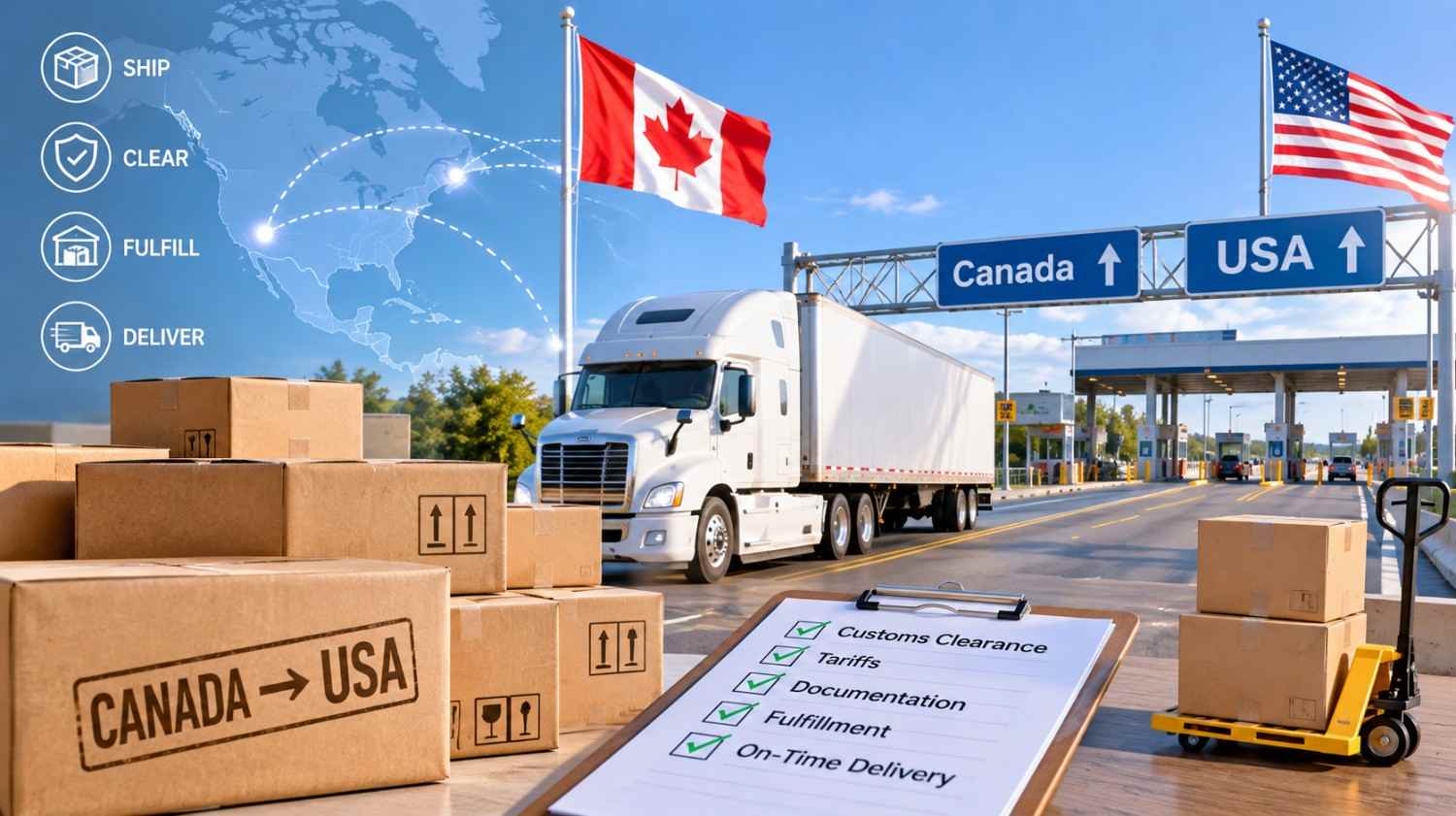
Crossing the Border: Navigating Customs, Tariffs, and Fulfillment from Canada to the USA

Crossing the Border

Crossing the Border: Navigating Customs, Tariffs, and Fulfillment from Canada to the USA

Expanding an eCommerce business from Canada to the USA can open access to a much larger customer market, but cross-border selling requires more than simply listing products on an American marketplace. Customs documentation, product classification, country of origin, tariffs, shipping arrangements, inventory planning, and fulfillment all need to work together.


For Canadian brands selling through Amazon, Walmart, eBay, Shopify, Etsy, and other channels, understanding the Canada-to-USA shipping process can help reduce unexpected costs and delivery problems.


Understanding Cross-Border Customs

Every commercial shipment entering the USA must meet applicable customs requirements. The classification of a product under the Harmonized Tariff Schedule helps determine the applicable duty treatment and other requirements. U.S. Customs and Border Protection notes that the correct duty rate depends on factors including the product’s classification and country of origin.


For an eCommerce seller, accurate product information is therefore essential. Product descriptions, quantities, declared values, country of origin, and classification information should be consistent across commercial invoices, shipping documentation, and marketplace records.


A small documentation error can create delays, additional processing, or unexpected costs. Building a standardized cross-border shipping workflow can make the process more manageable as order volume increases.


How Tariffs Can Affect Canadian Products

Tariffs are one of the most important considerations when shipping products from Canada to the USA. The amount applicable to a product can depend on its classification, origin, applicable trade programs, and current U.S. tariff measures.


Products that qualify under the United States-Mexico-Canada Agreement (USMCA) may receive preferential tariff treatment when the applicable origin requirements are satisfied. Businesses should maintain appropriate origin documentation and make accurate claims when requesting preferential treatment. CBP guidance explains that preferential treatment requires the importer to possess valid origin documentation for qualifying goods.


However, Canadian origin does not automatically mean every product receives the same tariff treatment. Products manufactured in Canada may contain materials from other countries, and the applicable origin rules can vary by product category.


Because tariff policies can change, sellers should verify the current requirements for their specific products before setting prices or calculating margins.


Why Product Classification Matters

Product classification is an important part of international eCommerce fulfillment. A product’s tariff classification can influence the duty rate and whether additional requirements apply.


For example, two products that appear similar to a consumer may have different classifications because of their materials, construction, intended use, or manufacturing process.


This makes accurate product data particularly valuable for brands managing large catalogs. Maintaining organized SKU information, product specifications, country-of-origin data, and classification records can help create a more consistent cross-border operation.


Preparing Orders for the USA

Once a customer places an order, the fulfillment process should account for the destination country from the beginning. Canadian sellers should determine whether orders will be shipped individually from Canada or whether inventory should be positioned closer to U.S. customers.


Direct shipping from Canada can work well for certain products and order volumes. However, as sales increase, storing inventory in a U.S.-based fulfillment facility may provide a different operational model, potentially improving delivery speed and simplifying the customer experience.


The appropriate approach depends on product size, sales volume, customer locations, shipping costs, inventory turnover, and marketplace requirements.


Understanding the De Minimis Environment

Canadian sellers should not assume that low-value shipments automatically receive duty-free treatment in the USA. CBP states that, effective August 29, 2025, duty-free de minimis treatment was suspended for covered shipments entering the USA, including shipments valued at or below $800, subject to the applicable exceptions and rules.


This change makes it particularly important for eCommerce sellers to understand how their shipments are entered, what duties and fees may apply, and who is responsible for the import process.


The financial impact should be considered when developing product pricing, shipping charges, promotions, and marketplace margins.


Building a Reliable Fulfillment Strategy

Cross-border fulfillment should be designed around the complete customer journey rather than shipping alone. A strong system connects inventory management, marketplace orders, warehouse operations, shipping carriers, customs documentation, tracking, and customer communication.


For brands selling across multiple marketplaces, this becomes even more important. Inventory needs to remain synchronized across channels so that a product advertised as available can actually be fulfilled.


AMZ Northland supports brands with Marketplace Management, listing optimization, catalog management, inventory coordination, advertising, and cross-border marketplace strategies across Canada and the USA.


How eCommerce Businesses Can Reduce Cross-Border Problems

The most effective approach is to create a repeatable process before increasing international order volume. Product data should be standardized, shipping costs should be reviewed regularly, and customs information should be maintained accurately.


Businesses should also evaluate whether direct fulfillment from Canada or U.S.-based inventory makes more sense for each product category. Fast-moving products may justify localized inventory, while lower-volume products may continue to be shipped internationally.


Pricing should also account for more than product cost. Shipping, brokerage, duties, marketplace fees, fulfillment charges, returns, and other cross-border expenses can affect the actual margin on every sale.


The Role of Marketplace Management

Cross-border growth becomes more complex when a brand sells through several platforms. Each marketplace can have different listing requirements, fulfillment settings, pricing structures, advertising tools, and customer expectations.


Professional Marketplace Management can help coordinate these moving parts while maintaining consistent product information across sales channels.


AMZ Northland provides Online Marketplace Services for brands selling through Amazon, Walmart, eBay, Etsy, Shopify, Faire, Poshmark, and other eCommerce platforms. Its services include marketplace onboarding, listing optimization, marketplace SEO, catalog management, advertising support, and multi-marketplace growth strategies.


Supporting Cross-Border Growth With Better Product Content

Successful international eCommerce is not only about logistics. Customers also need clear product information and compelling visuals before they make a purchase.


High-quality product images, accurate descriptions, keyword-optimized listings, A+ content, and consistent branding can improve the shopping experience across marketplaces.


AMZ Northland combines e-Commerce Marketing, Marketplace Management, e-Commerce Photography, and Online Marketplace Services to help brands strengthen their digital presence while expanding across Canadian and U.S. marketplaces.


AMZ Northland for Canada-to-USA eCommerce Growth

Crossing the Canada-USA border for eCommerce fulfillment requires coordination between product data, customs, tariffs, inventory, shipping, marketplace operations, and customer experience. Businesses that establish these processes before scaling can create a more organized foundation for cross-border growth.


AMZ Northland helps Canadian brands and cross-border eCommerce businesses manage marketplace operations, product listings, catalog systems, advertising, e-Commerce Marketing, Marketplace Management, e-Commerce Photography, and Online Marketplace Services. With support across Amazon, Walmart, eBay, Etsy, Shopify, Faire, and other platforms, AMZ Northland helps businesses build structured marketplace operations across Canada and the USA.

Frequently Asked Questions

Cross-border eCommerce fulfillment is the process of storing, preparing, shipping, clearing, and delivering online orders from one country to customers in another. For Canadian businesses selling to U.S. customers, it includes shipping, customs documentation, tariff considerations, and delivery management.

The applicable duty depends on the product classification, country of origin, applicable trade agreements, and current tariff measures. Products qualifying under USMCA may receive preferential treatment when the relevant requirements are met.

Businesses should not assume that shipments valued at $800 or less automatically qualify for duty-free treatment. CBP states that duty-free de minimis treatment was suspended for covered shipments beginning August 29, 2025, subject to applicable exceptions and rules.

Requirements vary by shipment and product, but accurate product descriptions, value, quantity, country of origin, classification, and applicable documentation are important components of the import process. Product-specific requirements can also depend on other U.S. regulatory agencies.

It depends on sales volume, product characteristics, customer locations, shipping costs, and fulfillment requirements. U.S.-based inventory can be considered when faster delivery and localized fulfillment justify the additional operational cost.

Yes. AMZ Northland provides Marketplace Management and Online Marketplace Services across platforms including Amazon, Walmart, eBay, Etsy, Shopify, Faire, and Poshmark.

Yes. AMZ Northland provides e-Commerce Marketing and e-Commerce Photography alongside listing optimization, marketplace management, catalog support, and other eCommerce services.


Scaling DTC Brands: When to Bring SEO and Paid Media In-House vs. Outsourcing

Scaling DTC Brands

Scaling DTC Brands: When to Bring SEO and Paid Media In-House vs. Outsourcing

Direct-to-consumer (DTC) brands often reach a stage where their early marketing approach is no longer enough. As sales increase, product catalogs expand, advertising budgets grow, and customer acquisition becomes more competitive, businesses need to decide how much of their SEO and paid media activity should remain in-house and how much should be outsourced.


There is no single structure that works for every DTC brand. The right approach depends on business size, internal expertise, marketing complexity, growth objectives, and the ability to manage multiple channels efficiently.


When Should a DTC Brand Bring SEO In-House?

SEO can become a valuable long-term growth channel because it helps brands attract customers through organic search without paying for every visit. However, effective SEO requires ongoing keyword research, technical optimization, content development, product-page optimization, analytics, and performance monitoring.


An in-house SEO team can make sense when a brand has sufficient revenue, a large website or product catalog, and enough ongoing work to support dedicated specialists. Having SEO expertise internally can also make collaboration easier between marketing, product, content, technology, and merchandising teams.


For e-commerce brands, SEO should extend beyond the main website. Product pages, category pages, marketplace listings, structured content, and supporting articles can all contribute to search visibility. Marketplace SEO is particularly important for brands selling through Amazon and other online marketplaces.


When Is Outsourcing SEO More Practical?

Outsourcing SEO can provide access to specialized knowledge without requiring a DTC brand to build an entire internal team. This can be useful for growing businesses that need technical SEO, content strategy, marketplace SEO, GEO, AEO, or e-commerce optimization but do not yet have enough workload to justify multiple full-time specialists.


Modern search also makes SEO more complex. Businesses increasingly need to consider traditional search engines alongside AI-powered discovery and answer engines. GEO and AEO strategies can help businesses organize information so that it is easier for modern search systems and AI-driven experiences to understand.


For a growing DTC brand, outsourcing can therefore provide access to broader expertise while allowing the internal team to concentrate on products, customers, operations, and brand development.


When Should Paid Media Stay In-House?

Paid media requires continuous campaign management, budget control, testing, audience analysis, creative development, and performance optimization. Larger DTC brands with significant advertising budgets may benefit from having internal specialists who can work closely with finance, merchandising, creative, and product teams.


An in-house team can also develop deep knowledge of the brand’s customers and products. This can make it easier to coordinate campaigns with product launches, seasonal promotions, inventory availability, and customer retention strategies.


However, building an effective paid media department requires more than hiring one advertising specialist. Brands may eventually need expertise across paid search, marketplace advertising, social advertising, analytics, creative strategy, and conversion optimization.


When Should Paid Media Be Outsourced?

Outsourcing paid media can be practical when a brand needs specialized expertise without building a large internal department. External specialists can help manage campaign structures, keyword targeting, creative testing, marketplace advertising, reporting, and ongoing optimization.


This becomes particularly useful when a DTC brand sells through several channels. Amazon, Walmart, Shopify, eBay, Etsy, and other marketplaces each have different requirements and customer behaviors. Coordinating advertising across these channels can become increasingly complex as a business scales.


The best approach is often not simply choosing between internal and external teams. Some brands use a hybrid model in which internal employees control strategy and brand direction while external specialists handle technical execution, campaign optimization, marketplace operations, or specialized projects.


How Marketplace Management Fits Into DTC Growth

As DTC brands expand beyond their own websites, Marketplace Management becomes an important part of the overall growth strategy. Managing listings, catalogs, inventory information, advertising, content, and marketplace performance requires consistent processes.


Online Marketplace Services can help brands coordinate these activities across multiple sales channels. This can reduce operational complexity while maintaining consistent product information and brand presentation.


Professional e-Commerce Photography can also support marketplace growth by giving products stronger visual presentation. High-quality product imagery can communicate features, demonstrate use cases, and improve the customer experience across product pages.


Why E-Commerce Marketing Needs a Broader Strategy

E-Commerce Marketing should not operate separately from SEO, paid media, marketplace operations, and content. A strong strategy connects organic visibility, paid acquisition, product presentation, conversion optimization, and customer retention.


For example, SEO can bring organic visitors to a product page, paid media can generate additional targeted traffic, professional photography can improve product presentation, and marketplace optimization can help customers discover the product through third-party platforms.

GEO and AEO can add another layer by preparing useful, well-structured brand information for AI-powered search and answer-based discovery.


Choosing Between In-House, Outsourcing and Hybrid Models

The decision should be based on the capabilities a DTC brand needs rather than simply comparing agency fees with employee salaries.

If a brand has strong internal marketing leadership but lacks specialized technical expertise, outsourcing specific functions may be effective. If marketing is becoming a core competitive advantage and there is enough consistent workload, building an internal team may make sense.


A hybrid model can combine internal ownership with external execution. The internal team can establish brand positioning, priorities, budgets, and business objectives, while specialized partners provide SEO, paid media, Marketplace Management, e-Commerce Photography, analytics, or Online Marketplace Services.

The most scalable model is one that allows the brand to maintain strategic control while accessing the expertise required at each stage of growth.


How AMZ Northland Helps DTC Brands Scale

AMZ Northland supports e-commerce brands with a combination of marketplace strategy, SEO optimization, advertising management, product listing optimization, creative services, and multi-marketplace support. Its services cover e-Commerce Marketing, Marketplace Management, e-Commerce Photography, and Online Marketplace Services for brands operating across major e-commerce platforms.


For DTC brands deciding whether to build capabilities internally or outsource specialized functions, this type of integrated support can provide flexibility as the business grows. The objective is to create a scalable e-commerce operation where marketing, marketplace activity, product presentation, and search visibility work together rather than operating as disconnected functions.

Frequently Asked Questions

An in-house SEO team can become practical when a brand has consistent SEO requirements, sufficient marketing resources, and enough ongoing work to support dedicated specialists.

Yes. Outsourcing can provide access to specialized SEO expertise without requiring a brand to immediately build a complete internal SEO department.

The choice depends on advertising complexity, budget, internal expertise, and business objectives. Some brands manage strategy internally while outsourcing specialized campaign execution.

A hybrid model combines internal marketing leadership with external specialists. The internal team can manage brand strategy and business priorities while external experts handle selected marketing functions.

Marketplace Management helps coordinate listings, catalogs, advertising, content, and marketplace operations as brands expand across multiple online sales channels.

Professional e-Commerce Photography can improve product presentation, communicate product details clearly, and create stronger visual experiences across websites and marketplace listings.

SEO focuses on organic search visibility, while GEO and AEO address visibility and information discovery within generative and answer-based search experiences. Combining them can create a broader search visibility strategy.

Hiring Your First E-Commerce Agency: Red Flags, Green Flags, and ROI Expectations

Hiring Your First E Commerce Agency

Hiring Your First E-Commerce Agency: Red Flags, Green Flags, and ROI Expectations

Hiring your first e-commerce agency can be an important step for a growing online brand. As sales channels become more complex, businesses often need support with product listings, advertising, marketplace operations, product photography, SEO, inventory coordination, and performance analysis.


The challenge is choosing an agency that understands your business rather than simply selling a package of services. A good e-commerce partner should bring strategy, marketplace expertise, transparent communication, measurable objectives, and a clear understanding of your customers.


For businesses selling across Canada and the USA, selecting the right agency can also help create a more consistent approach across multiple marketplaces and digital channels.


Why Businesses Hire E-Commerce Agencies

Managing an online store independently can become difficult as product catalogs, marketplaces, advertising campaigns, and customer expectations grow. A business may start with one marketplace and eventually expand to Amazon, Walmart, eBay, Etsy, Shopify, Faire, or other channels.


Each platform has different listing requirements, customer behavior, advertising systems, and optimization opportunities. AMZ Northland’s marketplace services cover platforms including Amazon, Walmart, eBay, Etsy, Poshmark, Faire, and Shopify, with support across listing optimization, advertising, catalog management, creative services, and marketplace strategy.


An experienced agency can become an extension of an internal team, allowing business owners to focus on product development, customer relationships, and overall growth.


Red Flags to Watch Before Hiring an Agency

One of the biggest warning signs is a promise of guaranteed sales or unrealistic results without first understanding your products, margins, competition, marketplace history, and advertising budget. E-commerce performance depends on many variables, so an agency should explain what it can influence and how success will be measured.


Another red flag is a lack of transparency. If an agency cannot clearly explain what it will do each month, who will manage your account, what reporting you will receive, and how advertising spend is separated from service fees, you should ask more questions before signing.


Be cautious when an agency relies entirely on generic strategies. Your marketplace strategy should reflect your product category, target customers, pricing, competition, inventory position, and sales channels.


Poor communication is another concern. Marketplace management involves ongoing decisions, so you should know how frequently the agency communicates, how issues are escalated, and who is responsible for approvals.


Green Flags That Indicate a Strong Agency

A strong agency begins with questions. It should want to understand your products, current sales, marketplaces, business objectives, competitors, margins, advertising history, and operational challenges before recommending a strategy.


Look for an agency that explains its process clearly and connects its services with measurable business objectives. For example, listing optimization should be connected to visibility and conversion opportunities, while advertising management should be evaluated using appropriate performance metrics.


A capable agency should also understand the importance of product presentation. Professional e-Commerce Photography can strengthen product pages by presenting products clearly and consistently. AMZ Northland provides product photography, lifestyle imagery, infographics, and marketplace-focused creative services as part of its e-commerce support.


Another positive sign is multi-marketplace experience. If your business sells through several channels, an agency should understand how to maintain consistent product information while adapting listings and strategies for each platform.


What Should You Expect From Marketplace Management?

Marketplace Management is more than uploading products. It can include listing optimization, catalog management, advertising, inventory coordination, performance monitoring, account support, and marketplace growth planning.


A professional agency should establish a workflow for reviewing performance and identifying opportunities. AMZ Northland describes its Marketplace Management services as covering areas such as marketplace onboarding, listing management, SEO optimization, catalog and inventory management, advertising, reporting, and growth consulting.


For businesses that sell across multiple platforms, Online Marketplace Services can provide centralized expertise while allowing marketplace-specific strategies to be applied where needed.


How to Think About E-Commerce Agency ROI

ROI should not be evaluated only by asking whether sales increased after hiring an agency. A more complete evaluation considers revenue, advertising costs, agency fees, conversion rate, average order value, organic visibility, marketplace performance, operational efficiency, and profitability.


For example, an agency may improve product listings and conversion rates while reducing wasted advertising spend. Another business may benefit from better catalog organization and faster marketplace expansion rather than an immediate sales increase.


Before starting, establish a baseline. Record current revenue, advertising spend, conversion rate, traffic, average order value, marketplace sales, and other relevant metrics. Then agree on reporting intervals and realistic objectives.


The agency should also explain which metrics it will prioritize. This creates a more useful relationship than focusing exclusively on short-term revenue.


e-Commerce Marketing Should Connect Every Channel

Effective e-Commerce Marketing should connect product content, marketplace SEO, advertising, creative assets, customer experience, and analytics.


An agency should understand how these elements work together. A high advertising budget cannot compensate indefinitely for weak product pages, poor images, unclear descriptions, limited inventory, or an ineffective pricing strategy.


AMZ Northland positions its services around marketplace expertise, SEO optimization, advertising management, catalog management, creative services, and strategic consulting, supporting brands across major marketplaces in Canada and the USA.


Questions to Ask Before Signing a Contract

Before choosing an agency, ask how it will evaluate your current marketplace performance, which services are included, how reporting works, who manages your account, how advertising budgets are handled, and what happens if performance does not meet expectations.


You should also ask whether the agency can support your future growth. If you currently sell on Amazon but plan to expand to Walmart, eBay, Etsy, Shopify, or Faire, the right partner should be able to discuss how your marketplace strategy could evolve.

A clear scope of work and communication process can prevent misunderstandings and make the relationship easier to manage.


How AMZ Northland Supports E-Commerce Brands

AMZ Northland provides e-commerce consulting and marketplace management services designed to help brands improve their presence across Amazon, Walmart, eBay, Etsy, Poshmark, Faire, Shopify, and other platforms. Its services include listing optimization, marketplace SEO, advertising management, product photography, creative content, catalog management, and marketplace consulting.


For brands entering a new marketplace or managing multiple sales channels, AMZ Northland can provide support across e-Commerce Marketing, Marketplace Management, e-Commerce Photography, and Online Marketplace Services.


The right agency relationship should be based on clear expectations, transparent communication, relevant expertise, and measurable performance. Instead of choosing an agency because of a bold promise, evaluate how well its strategy fits your products, customers, marketplaces, budget, and long-term objectives.

Frequently Asked Questions

Look for relevant marketplace experience, transparent pricing, clear communication, measurable reporting, a defined strategy, and services that match your business objectives. The agency should understand your products and customers before recommending a solution.

Unrealistic sales guarantees, unclear pricing, poor communication, generic strategies, limited reporting, and vague service descriptions are important warning signs. Ask the agency to explain exactly what it will deliver and how performance will be evaluated.

The timeline varies according to the marketplace, product category, competition, listing quality, advertising budget, inventory, and starting performance. Some improvements can happen quickly, while sustainable marketplace growth may require ongoing optimization.

Compare performance before and after the engagement using relevant metrics such as revenue, advertising spend, conversion rate, organic visibility, customer acquisition cost, average order value, profitability, and operational efficiency.

Yes. Many agencies provide multi-marketplace support. AMZ Northland works with marketplaces including Amazon, Walmart, eBay, Etsy, Poshmark, Faire, and Shopify.

High-quality product photography can improve product presentation and help shoppers understand what they are purchasing. Professional images, lifestyle photography, and infographics can also create a more consistent brand experience across marketplace listings.

Yes. AMZ Northland offers marketplace management, e-Commerce Marketing, listing optimization, advertising, e-Commerce Photography, catalog support, consulting, and other Online Marketplace Services for brands selling across Canada and the USA.

Creating Digital Catalogs That Retail Buyers Can’t Resist

Creating Digital Catalogs That Retail Buyers Cant Resist

Creating Digital Catalogs That Retail Buyers Can’t Resist

Retail buyers are busy. They want to discover products quickly, understand what makes them valuable, compare options, and have enough information to make a confident purchasing decision. For brands, wholesalers, manufacturers, and suppliers, a professional digital catalog can make that process easier while creating a stronger first impression.


A modern digital catalog is much more than a collection of product images. It can function as a visual sales tool that brings together product photography, descriptions, specifications, pricing information, collections, and purchasing details in one organized experience.


For businesses selling through eCommerce websites and online marketplaces, a well-structured catalog can also create a consistent product presentation across multiple sales channels. Modern catalog systems increasingly focus on centralized product information that can support websites, marketplaces, B2B portals, and other digital channels.


What Makes a Digital Catalog Attractive to Retail Buyers?

A retail buyer should be able to understand your collection without having to search through multiple files, messages, spreadsheets, or product photos.


The strongest digital catalogs create a logical journey. Buyers can begin with a collection, explore categories, open individual products, review images and specifications, and understand the commercial information needed to move toward an order.


Professional organization is particularly important when a business has a large product range. Categories, collections, product variants, SKUs, and clear product information help buyers navigate the catalog more efficiently.


A live digital catalog can also reduce the problems associated with repeatedly sharing outdated PDFs or product information. Digital catalog platforms increasingly allow businesses to maintain product information centrally and share an updated catalog through a single link.


Start With High-Quality Product Photography

Photography is one of the most important elements of a digital catalog because retail buyers need to understand the product visually before considering it for their stores or online channels.

Images should show the product clearly from relevant angles and provide enough visual detail to understand its size, materials, colors, construction, and overall appearance.


For fashion accessories, bags, gift products, home products, and lifestyle merchandise, professional e-Commerce Photography can make the catalog considerably more appealing.

Consistent backgrounds, lighting, image dimensions, cropping, and product positioning create a cohesive collection. When every product follows the same visual standard, buyers can focus on the products instead of being distracted by inconsistent imagery.


Give Buyers the Information They Need

Beautiful images alone are not enough. Retail buyers also need practical information.

Every product page should communicate the information that helps a buyer evaluate the product. Depending on the category, this may include dimensions, materials, available colors, SKU information, product features, packaging information, wholesale pricing, minimum quantities, and customization options.


The goal is to answer common buyer questions before they need to contact the sales team.

This is also valuable for SEO, GEO, and AEO. Clear product information gives search engines and AI-powered discovery systems more structured information to understand and potentially surface when buyers search for specific products or suppliers.


Organize Products Around the Buyer

A catalog should be organized according to how retail buyers shop.

Instead of presenting hundreds of products on one long page, create logical collections. New arrivals, seasonal collections, best-selling products, gift collections, fashion accessories, sustainable products, and different product categories can help buyers reach relevant products faster.


A buyer looking for a specific product should not have to scroll through an entire catalog to find it.

Search, filtering, category navigation, and mobile-friendly layouts can become especially important as product ranges grow. Modern B2B digital catalogs commonly use categories, search, filters, product variants, and structured product information to make large collections easier to browse.


Make the Catalog Easy to Use on Mobile

Retail buyers do not always browse catalogs from a desktop computer. They may open a catalog from an email, social media message, WhatsApp conversation, or while traveling between stores.

A mobile-first catalog therefore needs clean navigation, readable product information, fast-loading images, and simple interactions.


The buyer should be able to open a product, understand it, move to another product, and return to the collection without getting lost.

A responsive digital catalog can also support Online Marketplace Services by creating a consistent source of product information that can be adapted for different marketplace requirements.


Connect Your Catalog With Your eCommerce Strategy

A digital catalog should not operate separately from the rest of your online sales strategy.

Product information can be developed with your website, marketplace listings, SEO strategy, content marketing, and eCommerce operations in mind.


For businesses selling across multiple channels, consistent product names, descriptions, images, specifications, and category information can make catalog management more efficient.

This is particularly important for Marketplace Management because retailers and marketplace customers often encounter the same product across different platforms. Consistent information helps create a recognizable brand experience.


Your catalog can also support e-Commerce Marketing by introducing collections, seasonal products, promotional campaigns, and buyer-focused content that connects product discovery with commercial goals.


Use Content That Helps Buyers Make Decisions

Retail buyers are not simply looking at products. They are evaluating whether those products could work for their customers.

Instead of relying on generic product descriptions, explain the practical value of each product. Highlight suitable retail categories, design characteristics, materials, color options, product applications, and merchandising opportunities where appropriate.


For example, a bag supplier can organize products by style, material, seasonal collection, gifting purpose, or retail application. This allows a buyer to quickly identify products that fit their store concept.

Strong product content also creates additional opportunities for SEO, GEO, and AEO by naturally answering the questions buyers may use when searching online.


Turn Your Catalog Into a Sales Tool

The ultimate purpose of a digital catalog is not simply to look attractive. It should help move buyers toward the next stage of the purchasing journey.


Include clear contact options, inquiry forms, product enquiry buttons, downloadable information where useful, and simple ways to connect with the sales team.

For B2B businesses, a structured catalog can also reduce the confusion that often comes from sending individual product photos, spreadsheets, and price lists through multiple communication channels. Digital catalog systems can bring product information and buyer inquiries into a more organized workflow.


Build a Digital Catalog That Converts Interest Into Opportunity

A successful digital catalog combines strong visuals, useful product information, logical organization, mobile-friendly design, and a clear path toward inquiry or purchase. When connected with eCommerce Marketing, Marketplace Management, e-Commerce Photography, and Online Marketplace Services, it can become an important part of a modern B2B sales strategy.


AMZ Northland helps brands and product businesses strengthen their online presence through eCommerce and marketplace-focused solutions. From product presentation and e-Commerce Photography to Marketplace Management and Online Marketplace Services, AMZ Northland can help businesses create a more consistent digital buying experience for retail customers across Canada and the USA.

Frequently Asked Questions

A digital catalog is an online presentation of a company’s products that allows buyers to browse product images, descriptions, specifications, collections, and other purchasing information through a website or shareable link.

A professional catalog should include high-quality product photography, clear product descriptions, categories, product specifications, SKUs, variants, pricing information where appropriate, and simple contact or inquiry options.

Professional product photography gives buyers a clearer understanding of the product and creates a consistent visual presentation. High-quality e-Commerce Photography can also strengthen the overall perception of a brand.

Yes. Digital catalogs can make large product collections easier for retailers and other business buyers to browse. They can also organize products, collections, variants, and commercial information in one place.

Well-organized product information, descriptive content, structured headings, relevant keywords, and clear answers to buyer questions can help search engines and AI-powered systems better understand a business and its products.

Yes. Buyers may access catalogs from smartphones and tablets, so responsive design, readable text, optimized images, simple navigation, and fast loading are important considerations.

A well-organized catalog can provide a structured foundation for product information used across eCommerce websites and marketplace channels. This can support Online Marketplace Services and Marketplace Management by helping businesses maintain more consistent product information.